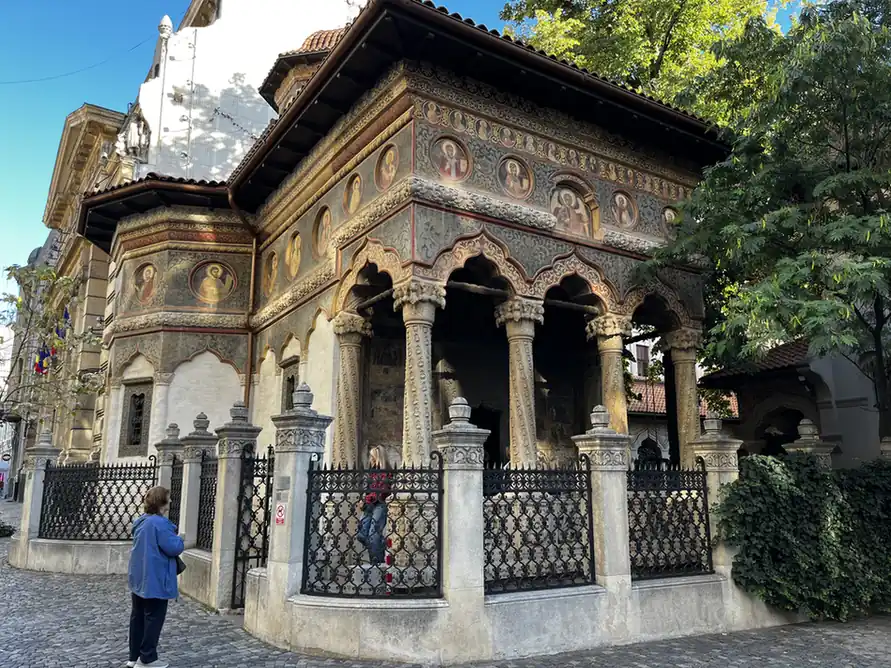
Stavropoleos Monastery is a small Orthodox monastery in Bucharest’s Old Town, known for its carved stone porch, painted church and courtyard. You can walk past the building in a minute, but there is much more to notice once you stop at the entrance and look inside.
I photographed the church, its painted ceilings and the stone collection in the courtyard during my visit on 3 October 2026. This guide takes you through those details, with the history behind them and the practical information you need for a visit.
Stavropoleos Monastery at a Glance
Visitor quick guide · Stavropoleos Monastery
Ratings checked 3 October 2026 · Tripadvisor Travelers’ Choice 2026 · scores and review counts can change.
Why Visit Stavropoleos Monastery?
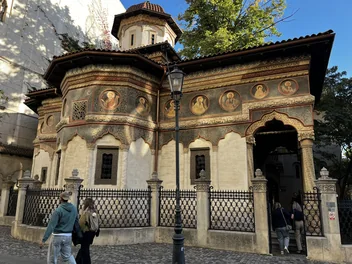
The church is compact, which makes the details easy to miss if you only look at it from the street. Its porch has carved columns and arches, the outside walls carry painted saints’ medallions, and the interior is covered with religious scenes. The courtyard adds a different view of the church, with greenery and covered galleries around it.
Stavropoleos is also a working monastery with a community of nuns. Prayer, restoration work and study remain part of its daily life. The monastery has a strong Byzantine music tradition; chanting belongs to its services, so check the official service calendar if that interests you.
The History of Stavropoleos Monastery
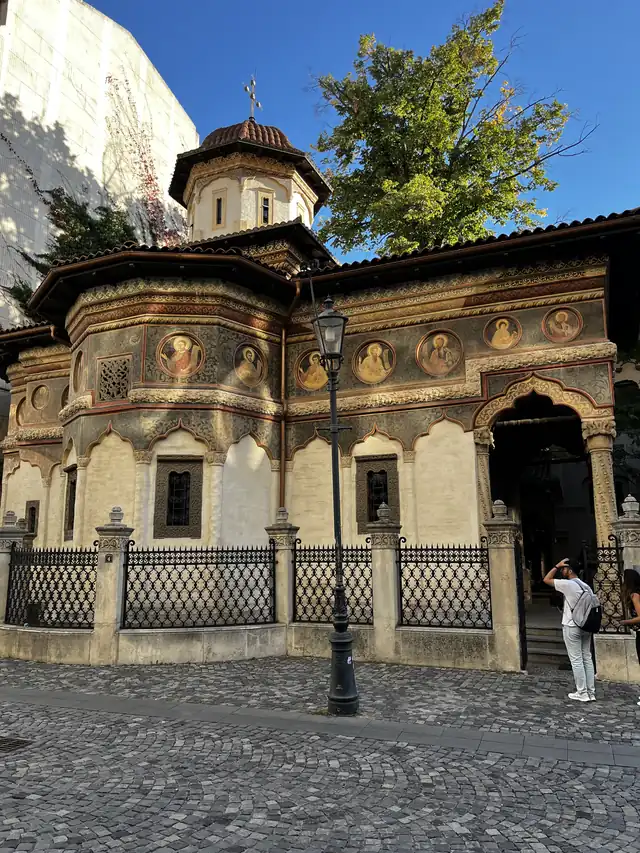
The monastery was founded in 1724 by the Greek archimandrite Ioanichie, who came from Epirus. He first established an inn for travellers and merchants, then built the church. Income from the inn helped support the religious community, linking the monastery to the commercial life of the surrounding streets.
In 1726, Ioanichie became Metropolitan of Stavropolis, and the monastery took the name Stavropoleos. The name is associated with the Greek expression for “City of the Cross”. The Archdiocese’s historical account explains this connection.
- 1724: Ioanichie founded the church and monastery, supported by his inn.
- 1730s: The church was enlarged, including the addition of its decorated porch.
- Late 19th century: The inn and surrounding buildings were demolished, leaving the church.
- Early 20th century: Architect Ion Mincu’s restoration brought a new courtyard enclosure and arcaded galleries. The church reopened for worship in 1940.
- 1991–2008: A new period of restoration began under Father Iustin Marchiș. Stavropoleos was re-established as a monastery for nuns in 2008.
This helps explain what you see today: the church and courtyard belong to different periods. The church comes from the 18th-century foundation, while the surrounding galleries are part of the later rebuilding. See the monastery’s official history for the full story.
What to See at Stavropoleos Monastery
The Exterior and Entrance Porch
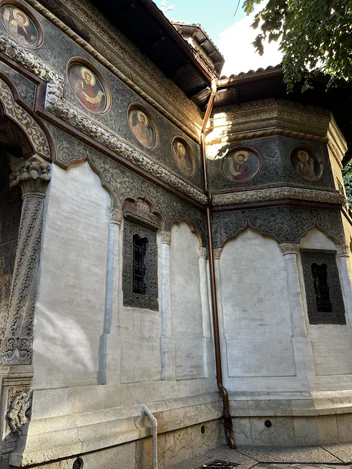
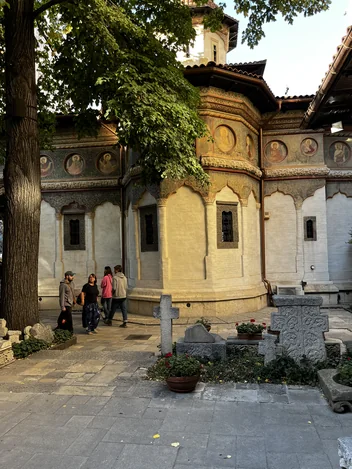
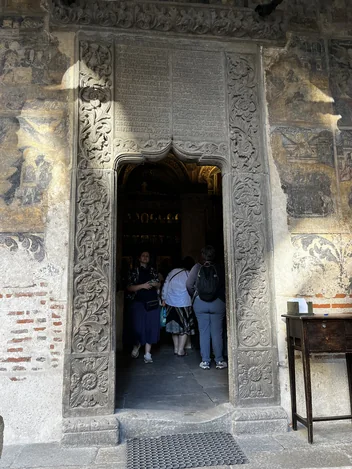
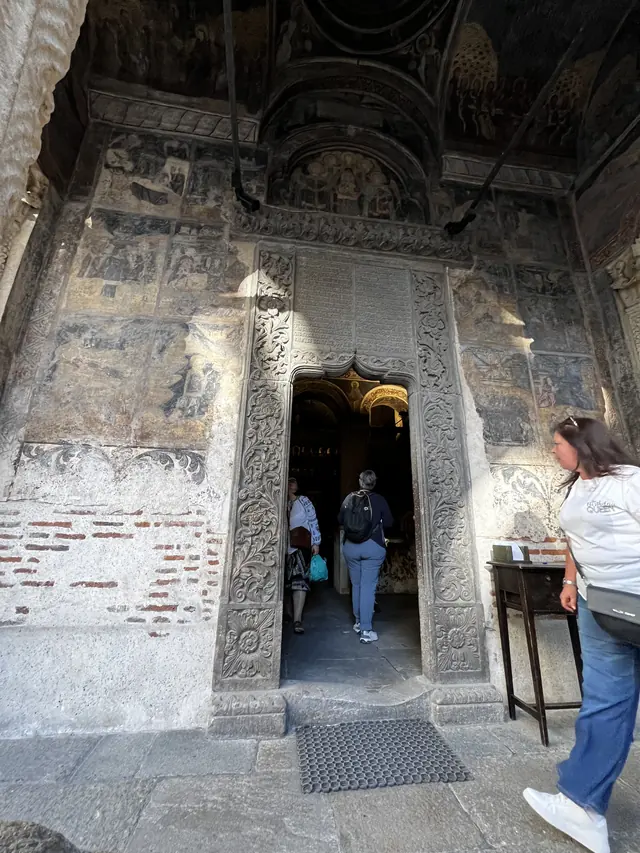
Start with the porch before going inside. The columns, arches and doorway are covered with carving, while painted medallions run along the walls above. Walk around the accessible sides of the church and you can see how the stone decoration continues beyond the entrance.
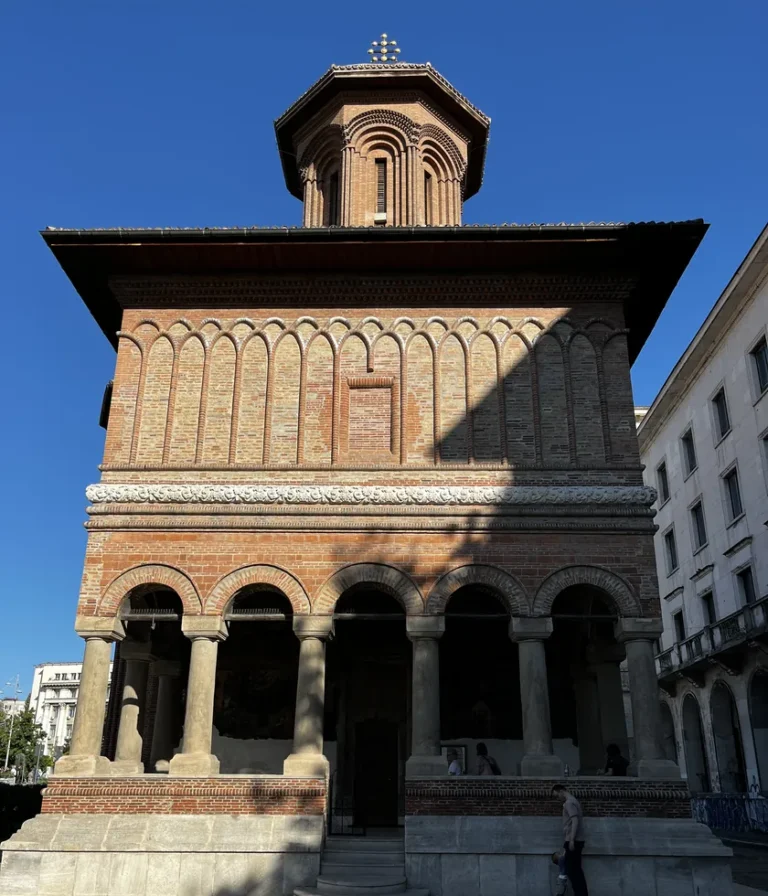
Stavropoleos is a good example of Brâncovenesc architecture, a Romanian architectural tradition recognisable here in the carved stone, decorated columns and ornate arches. Start with a few details: look at the leaf patterns, the column capitals and the shapes of the arches. For another example of Brâncovenesc architecture, compare the carved porch at Kretzulescu Church beside Revolution Square.
Inside the Church and the Iconostasis
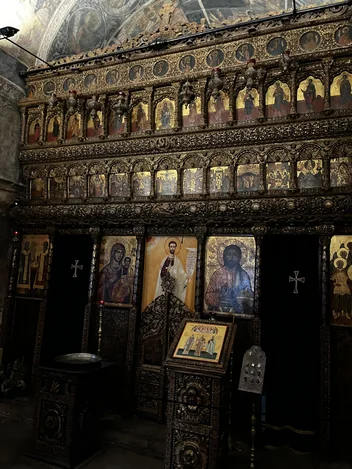
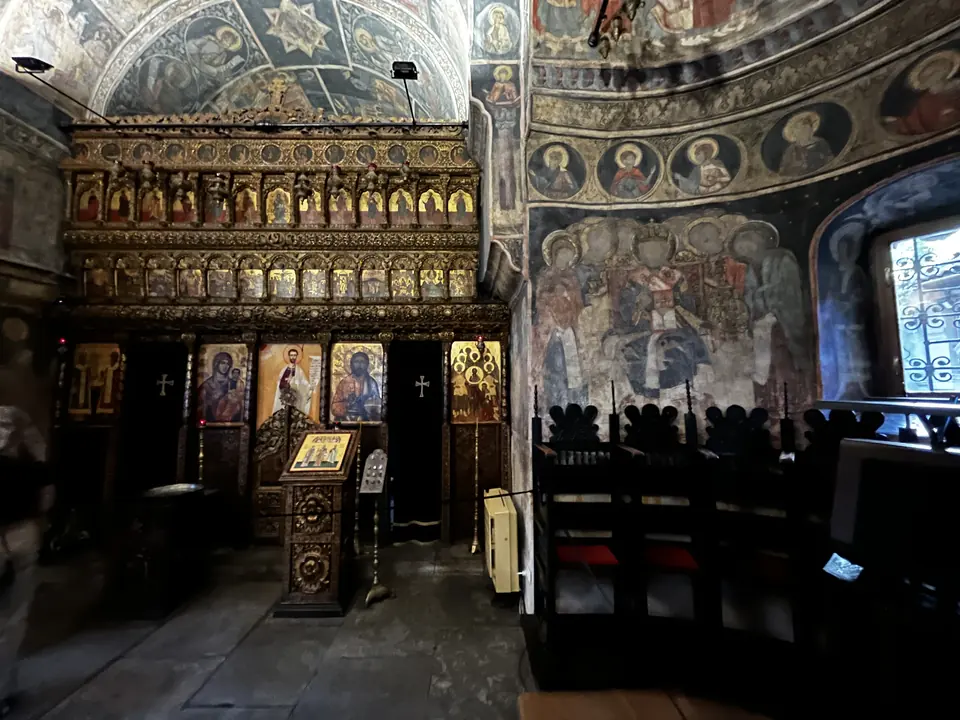
Inside, the space is small and richly decorated. Painted scenes cover the walls, and a wooden screen filled with icons stands at the eastern end. This is the iconostasis, which separates the main worship space from the sanctuary.
Look at the carved wood between the icons as well as the paintings themselves. The rows of small figures, decorative foliage and gilded details give you plenty to notice even in a short visit. Leave space around the icon stands and doorway for people coming to pray.
The Painted Ceilings
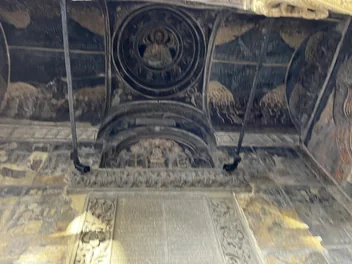
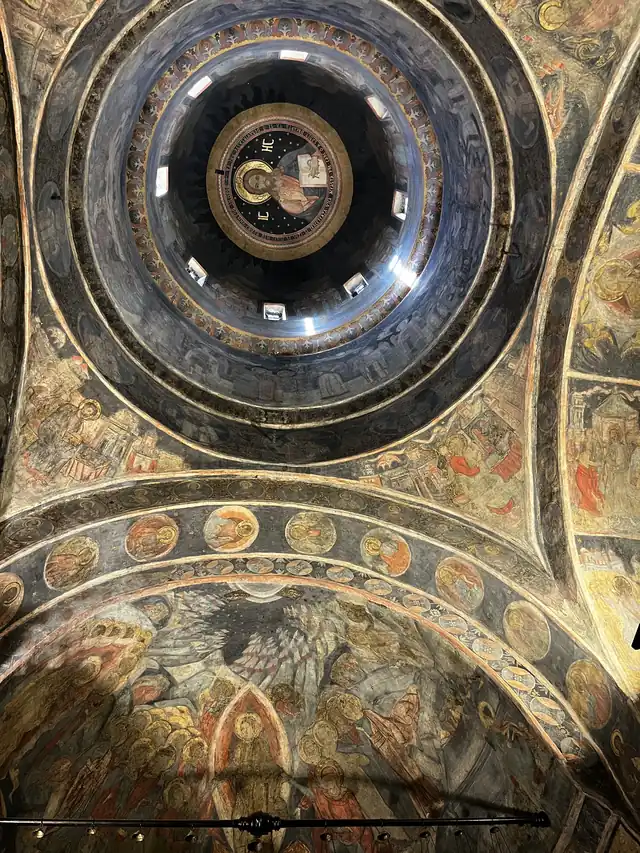
Look up at the arches and dome, then look at the ceiling beneath the entrance porch. The painted scenes continue overhead, so a quick glance at the walls only shows part of the decoration.
One detail from the official church description is easy to overlook: much of the original mural ensemble survives, but the dome was rebuilt and painted after 1900. The paintings you see do not all date from the original 1724 building.
The Courtyard and Covered Galleries
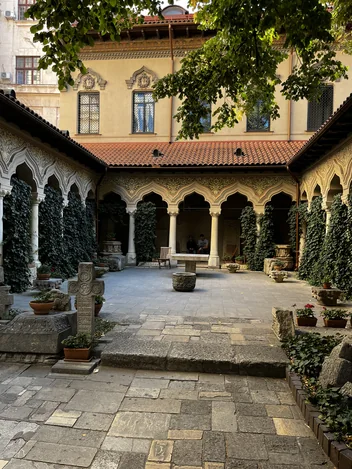
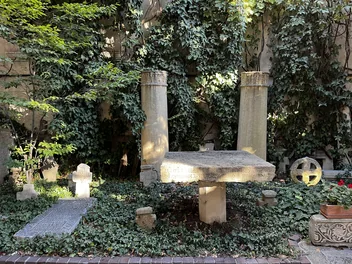
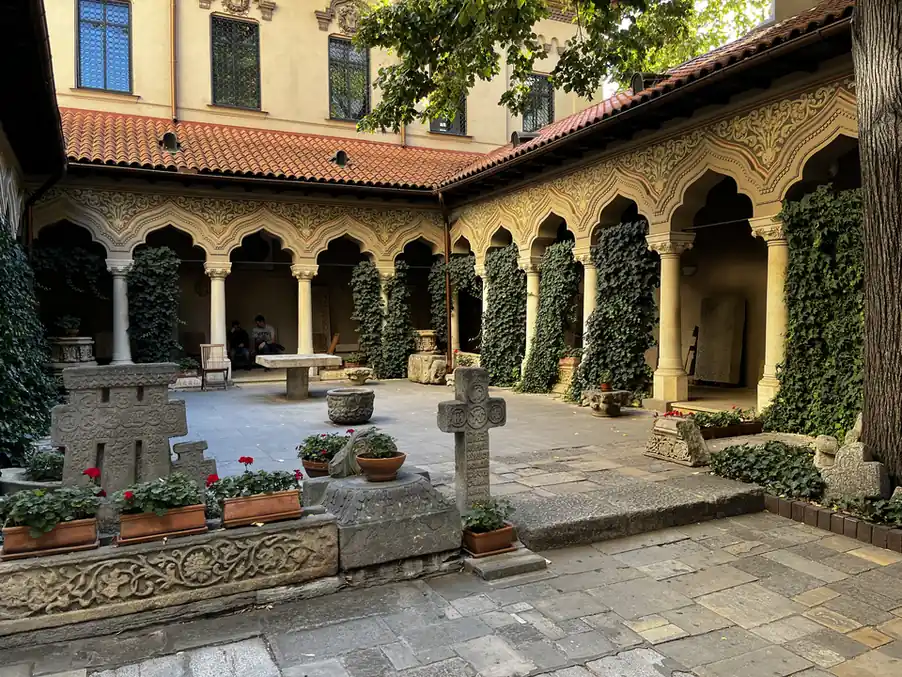
Continue into the courtyard and you see the church from another angle. There are carved stone columns, covered walkways, flowerpots and a small planted area. I photographed both the open courtyard and the gallery corridors; they show a part of Stavropoleos you cannot appreciate from the street.
The enclosure was designed by Ion Mincu during the later restoration, in the Neo-Romanian style. Its galleries extend around three sides of the courtyard. Keep to the areas open to visitors, as the surrounding buildings also serve the monastery.
The Stone Collection: Bucharest’s Lost Churches
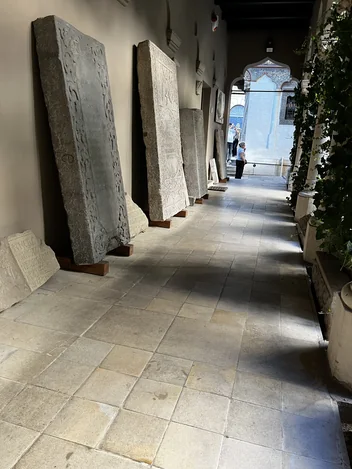
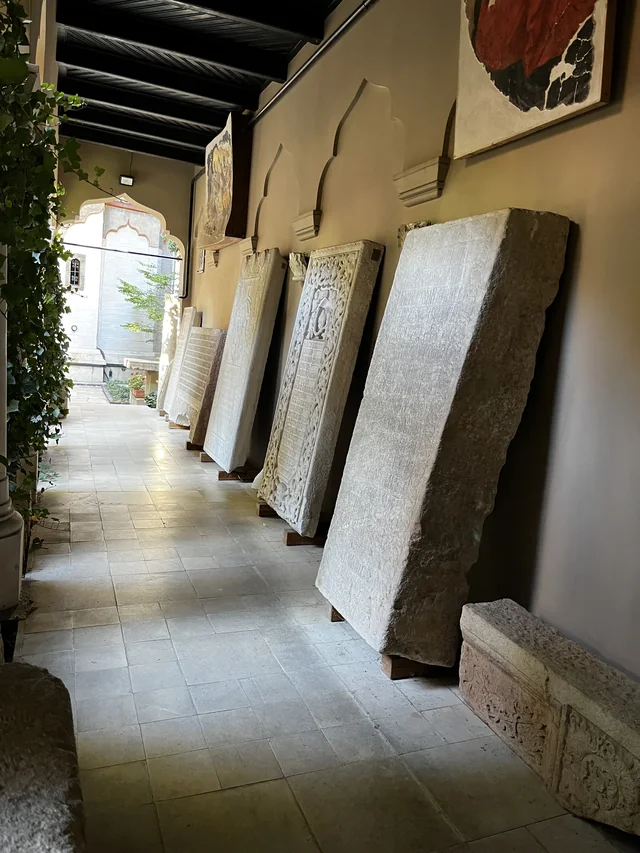
Under the covered galleries, look for the inscribed slabs, crosses and fragments of carved stone. This collection is called a lapidarium, a place where historic stone objects are preserved.
The collection includes tombstones and architectural pieces from churches that disappeared as Bucharest changed. Some were recovered from buildings demolished in the late 19th and early 20th centuries. Look closely at the different lettering and carved borders; the courtyard holds pieces of the city’s history beyond this one monastery.
The monastery also holds a separate collection of icons, church art and other saved objects, described on its patrimony page. Ask in advance about museum or library access if you want to see more than the church and courtyard.
The 3D Virtual Tour
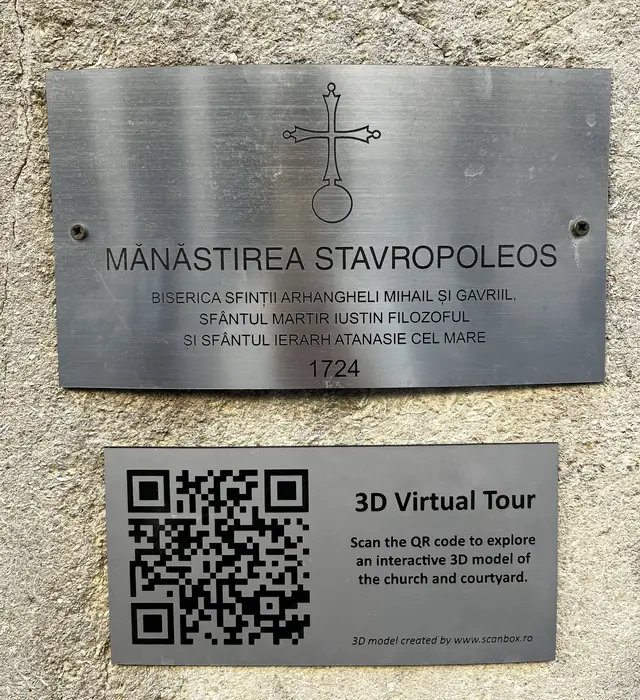
There is a 3D Virtual Tour sign beside the monastery plaque. You can scan its QR code on site, or open the tour below before your visit.
The tour was created with Scanbox and includes the church, courtyard, library, refectory and museum. It gives you a way to look inside spaces that may need a separate enquiry for an in-person visit. The Romanian Orthodox Church’s news agency reported its launch in 2020, and it remains linked from the official monastery website.
How to Get to Stavropoleos Monastery
Walking and Metro
The monastery is at Strada Stavropoleos 4, at the corner with Strada Poștei in the Old Town. It is easy to reach on foot from the surrounding pedestrian streets.
For the metro, use Universitate on line M2, or Piața Unirii on lines M1, M2 and M3. Allow roughly 10 minutes to walk from either station, depending on the exit you use. The last part of the journey is through the Old Town streets.
Coming by Car and Nearby Parking
Plan to park around the edge of the Old Town and walk to the monastery. Here are six nearby parking areas, with their street addresses and zone codes, researched using Am Parcat’s Bucharest directory.
Total Spots means the listed capacity, not spaces currently free. Street-zone markers show approximate areas rather than a guaranteed car park entrance. Check the signs for the exact paid bays, tariff and payment instructions when you arrive.
| Parking | Address / zone | Total Spots | Directions |
|---|---|---|---|
| Doamnei 1 Parking | Strada Doamnei · P3288 | 23 | Get directions |
| Eforie Parking | Strada Eforie · P9266 | 48 | Get directions |
| Alexandru Beldiman Parking | Strada Alexandru Beldiman · P3982 | 47 | Get directions |
| Domnița Anastasia Parking | Strada Domnița Anastasia · P9099 | 57 | Get directions |
| Anghel Saligny Parking | Strada Anghel Saligny · P1413 | 86 | Get directions |
| Academiei Parking | Strada Academiei · P0101 | 106 | Get directions |
[→ View all parking spots on the map]
Parking capacities checked 3 October 2026.
Frequently Asked Questions
Yes. An ordinary visit to the church is free, with no admission ticket. Paid walking tours sold online are separate from admission to the monastery.
The official homepage and contact page list 08:00–19:00 daily, but the church page lists Monday–Saturday 10:00–18:00 and Sunday 13:00–18:00. Check the current schedule before travelling, particularly for an early visit. Access must respect services, prayer and confession.
Both names are used. Stavropoleos is an active Orthodox monastery with a community of nuns, and the historic church is the main building most visitors enter. The monastery was re-established for nuns in 2008.
I would allow 20–30 minutes for the church, courtyard and stone collection. You can make a shorter stop, but give yourself time to look at the carved porch, painted ceilings and inscriptions.
The photos in this guide include the church interior and courtyard from my October 2026 visit. Follow the signs and any instructions given on the day. Keep the doorway clear, avoid flash during worship and ask before photographing a service or using larger equipment.
Ask the monastery in advance about access. A normal church and courtyard visit should not be treated as guaranteed access to the museum, library or residential areas. The official 3D tour offers a look inside several of these spaces.
Dress modestly, with shoulders and knees covered, and keep your voice low. This is practical advice for visiting an active place of worship. Give priority to worshippers and follow any instructions at the entrance.
Stavropoleos Monastery Photo Gallery
More photographs from my visit on 3 October 2026, including the exterior, iconostasis, courtyard and stone galleries.