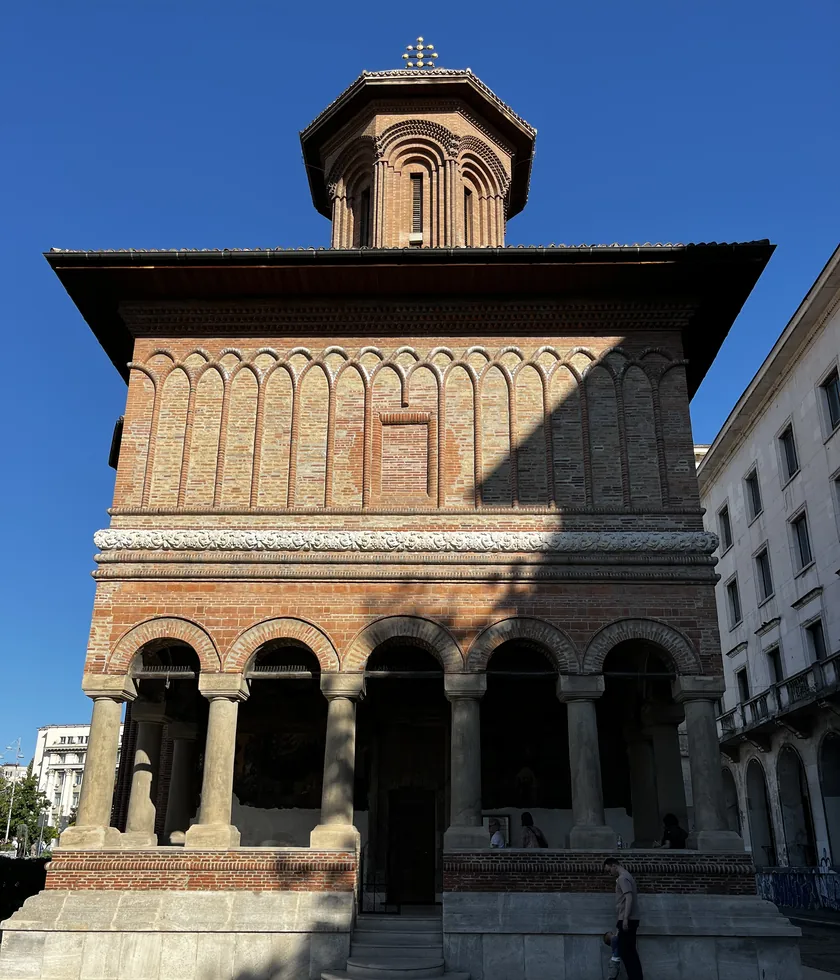
Kretzulescu Church stands on Calea Victoriei at the edge of Revolution Square, beside Bucharest’s former Royal Palace. Its red-brick walls and open stone porch are easy to spot, but the entrance paintings and interior murals reward a closer look.
The church was built between 1720 and 1722 for Iordache Kretzulescu and Safta Brâncoveanu, and remains one of the capital’s notable Brâncovenesc monuments. The Bucharest Archdiocese’s virtual tour describes its architecture and surviving frescoes.
This is an active Orthodox parish, not a museum. I visited on 4 October 2026 and photographed the porch, entrance and interior; the visit notes below distinguish what I saw from the church’s historical record.
Check the parish’s current hours and weekly service schedule before you go, since worship takes priority over sightseeing.
Kretzulescu Church at a Glance
At a glance
What to See at Kretzulescu Church
The Red-Brick Façade and Open Porch
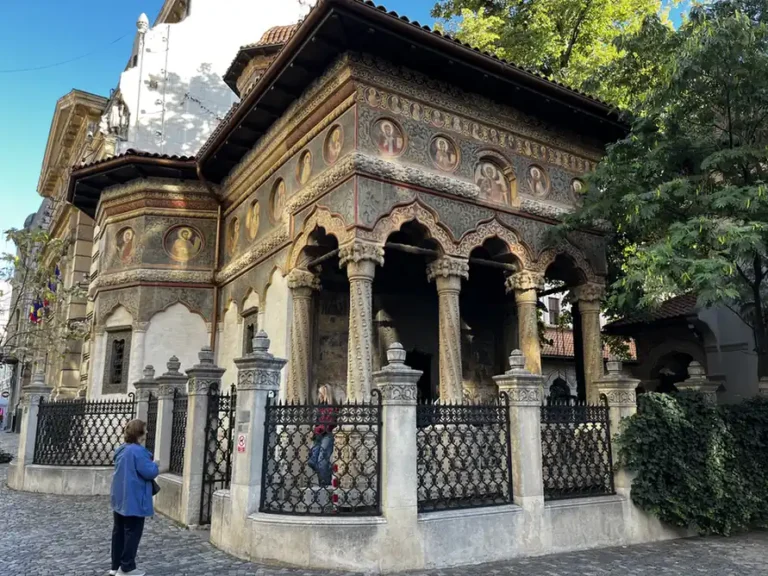
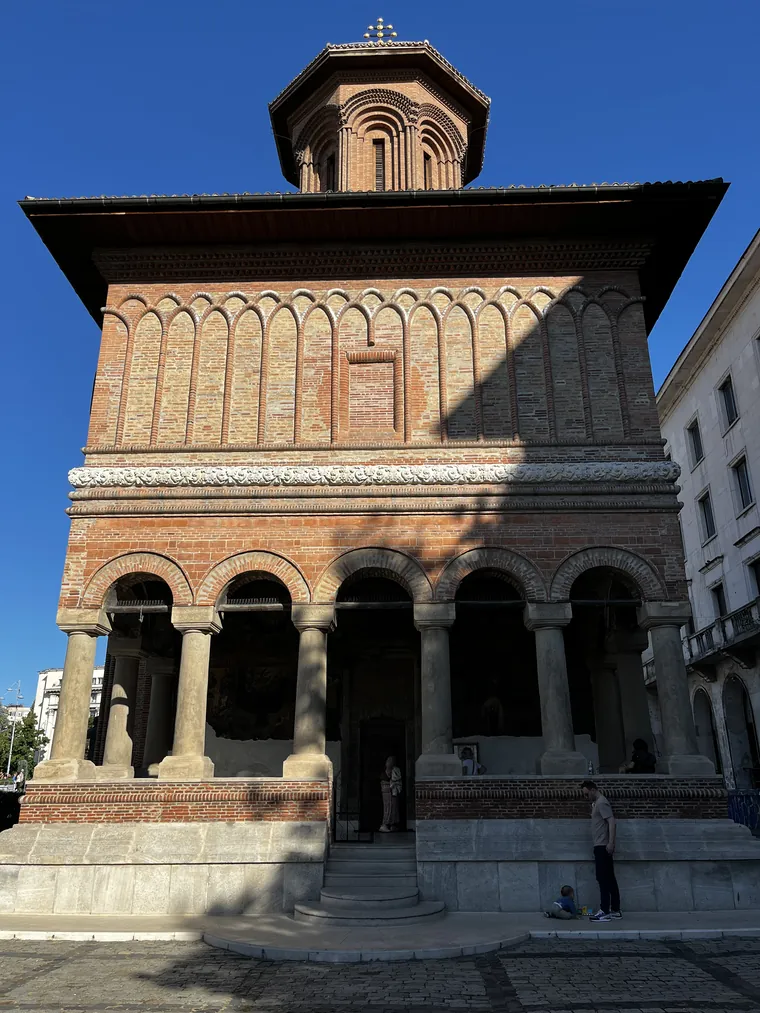
Start with the façade from the pavement. The church’s red brick is divided by pale stone bands and framed by a broad, open porch. Six stone columns carry its arches, making the entrance feel sheltered without hiding the paintings within.
This mix of brickwork, stone carving and a deep porch is part of the building’s Brâncovenesc character; a Romanian architecture guide also notes the six-column porch and the church’s exposed brick walls. Stavropoleos Monastery in the Old Town offers another view of Brâncovenesc architecture, with an ornate carved porch and courtyard.
From the square, take a moment to look along the building rather than only at the central tower. The masonry panels and stone belt break up the red exterior, while the porch gives you a close view of the capitals and carved details.
The façade’s present appearance reflects restoration work, not an untouched surface from 1722.
Painted Porch and Carved Entrance
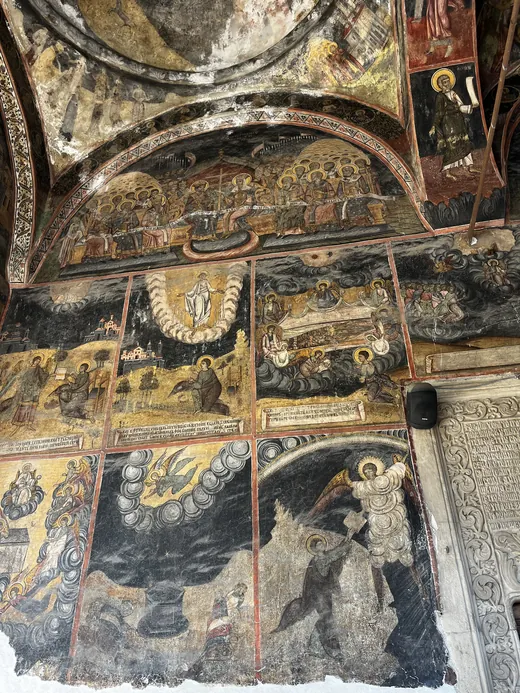
The porch is more than a covered threshold. Its vaulted surfaces carry religious scenes, including imagery that specialists identify with the Book of Revelation.
The Bucharest Municipal Museum describes Revelation scenes at Kretzulescu as a rare subject in the city’s 18th-century church painting.
Look up as you enter: the worn, layered panels spread across the vaults and walls, so a quick glance at the doorway can miss much of the composition.
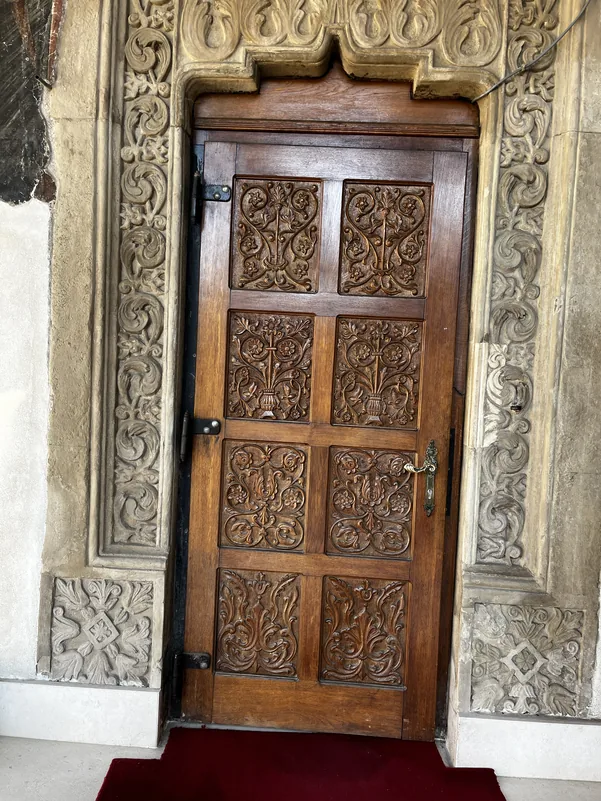
Beside the paintings, the entrance door is set within a carved stone surround.
The floral patterns in the timber panels echo the stone ornament around them.
It is an easy detail to pass if you step straight into the nave, so pause at the entrance before moving inside.
Inside: Frescoes and the Iconostasis
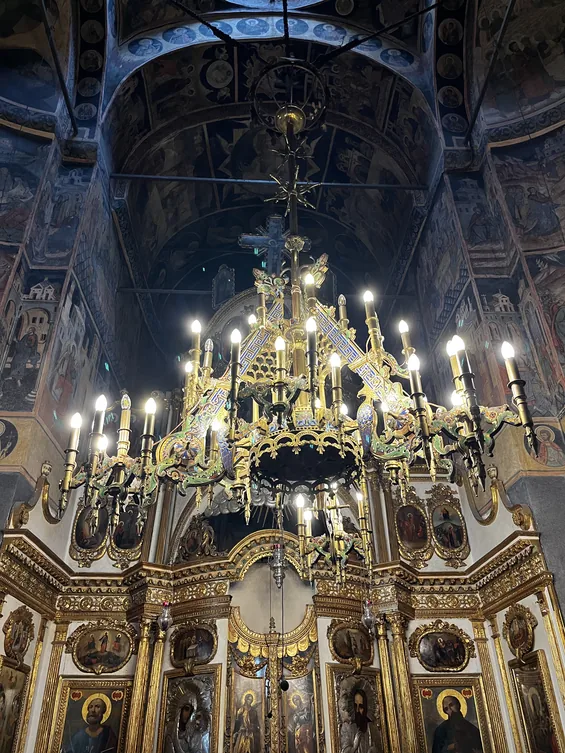
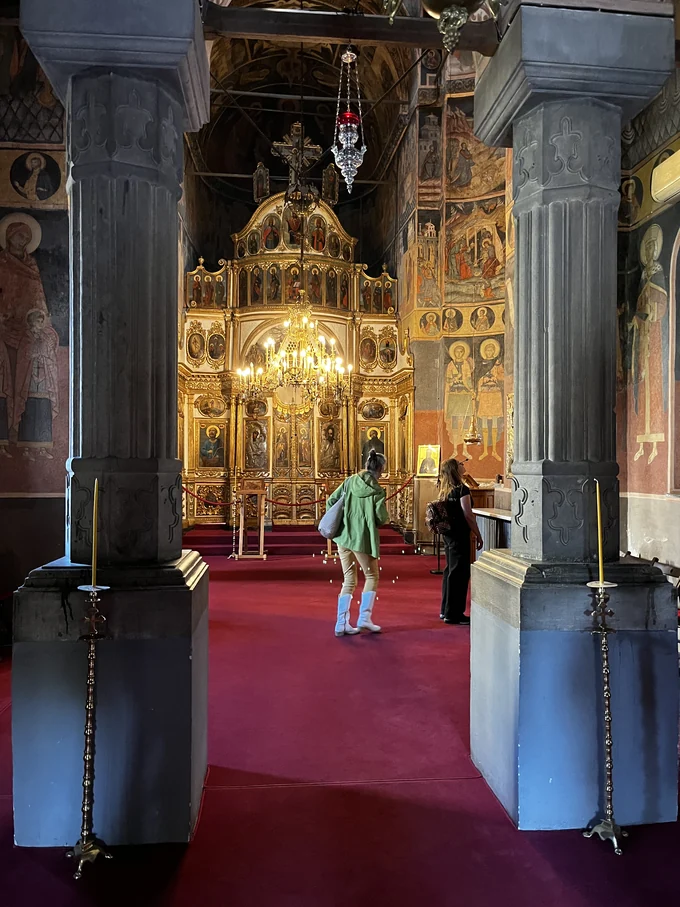
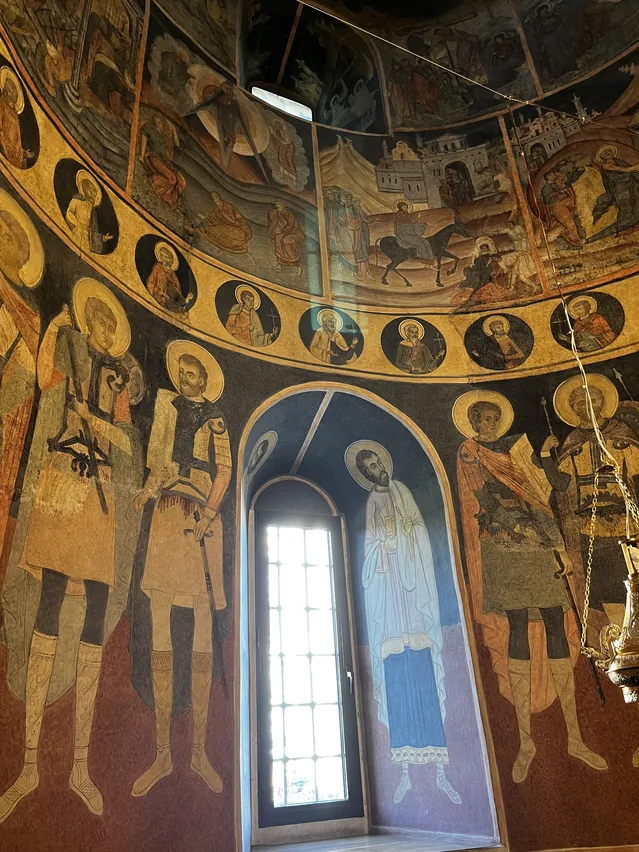
Inside, the gilded iconostasis draws your eye toward the altar, but painted figures and narrative scenes continue across the walls, arches and window bays. Some sections are darkened and visibly incomplete.
The present interior brings together surviving early painting, later conservation and restored furnishings; it should not be read as a single untouched decorative scheme.
The chandelier hangs in front of the upper altar screen, and its bright metal contrasts with the older, earth-toned frescoes.
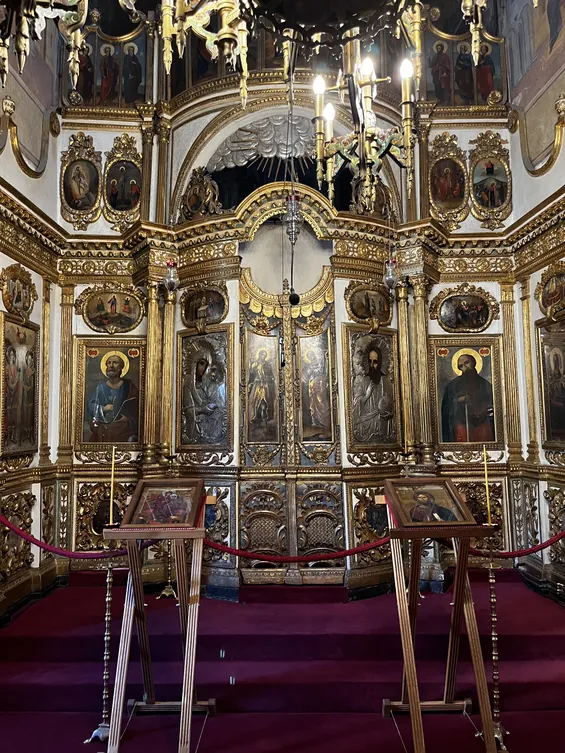
A close view of the iconostasis shows rows of framed icons, carved and gilded details, and a rope boundary in front of the sanctuary. If a service is underway, keep to the visitor area and do not move closer for a photograph.
History and Restoration
The Founders and the 18th-Century Church
Logothete Iordache Kretzulescu and his wife Safta Brâncoveanu, a daughter of Prince Constantin Brâncoveanu, built the church between 1720 and 1722. The parish and Bucharest Archdiocese use these dates for the present building.
A heritage record lists a much earlier founding tradition, around 1638–1640, but notes that the painted inscription from 1863 leaves the founding year blank.
Treat that earlier date as a tradition about a predecessor church on the site, not as the construction date of the building you see today. CIMEC’s heritage record preserves both details.
The church has changed substantially since its founding. After the 1838 earthquake, architect Luigi Ludovic Lipizer carried out restoration work in 1860, when painter Gheorghe Tattarescu also worked on the interior.
Later restoration brought the older frescoes back into view. The Archdiocese’s virtual tour says that only the votive panel from Tattarescu’s painting survives; that panel preserves a later layer of the church’s story alongside the earlier murals.
Restoration and Survival
In the 1930s, architect Ștefan Balș and the Historical Monuments Commission led another major restoration. The church’s exterior was left in exposed red brick, and work on the interior revealed early 18th-century painting beneath the later layer.
Accounts differ on the exact span of this campaign, so the decade is the clearest shared description.
You can still see how these choices shaped the building: the brickwork outside is restrained, while inside the frescoes preserve both surviving passages and carefully completed areas.
The church also faced demolition during the communist period. In a 2022 interview published by the Bucharest Archdiocese, parish priest Vasile Răducă recalled that worship at the church was stopped in 1986, the parish was dissolved in 1988, and demolition was planned for 1989.
Architects and historians pressed for the building to be saved, and the plan was delayed before the December Revolution ended it. The church survived as a place of worship and a historic landmark beside Revolution Square.
Restoration continued after the parish was re-established in 1993. The same interview describes structural work, a renewed roof, facade repairs and the treatment of the paintings.
The parish priest said about 40 percent of the early mural was missing when the work was undertaken, so gaps were completed in the style of early 18th-century painting. A later Archdiocese virtual tour also records restoration of icons, the iconostasis and carved details.
Read the Archdiocese interview with the parish priest for his account of the conservation work and the church’s near-demolition.
Visiting Kretzulescu Church
Hours and Services
The parish website lists the church as open daily from 08:00 to 18:00. These are the published parish hours, not a guarantee that every part of the building will be open to visitors throughout the day.
Kretzulescu is an active church, and access may be limited during services or parish activity. Check the current weekly liturgical program before setting out; if you need to confirm access, the parish lists +40 727 781 718.
For a short architectural stop, plan around 20–30 minutes to look at the porch and the interior without rushing. Add time if you want to study the painted scenes. Keep in mind that this estimate is for planning; a service, ceremony or parish event can change the visit.
Photography and Etiquette
A bilingual notice at the entrance, photographed during my 4 October visit, prohibits flash photography generally and photography during church services. Ask before taking non-flash photographs inside, and follow any direction from parish staff.
Silence your phone, speak quietly, dress modestly, and leave room for worshippers to move through the nave and porch.
How to Get There
Use Revolution Square and the former Royal Palace as landmarks.
The church stands on Calea Victoriei beside the palace, now the National Museum of Art of Romania.
From the Old Town, walk north along Calea Victoriei toward the square; from the square, look along the avenue beside the museum.
Published street numbers vary between 45 and 47, so search for “Kretzulescu Church” in Maps if a number does not resolve clearly.
On a longer central walk, you can continue south toward the Old Town and our Museum of Communism visitor guide.
You can also follow Calea Victoriei north to the Romanian Athenaeum.
Open Kretzulescu Church in Google Maps
Frequently Asked Questions
It is on Calea Victoriei beside Revolution Square and the former Royal Palace, now the National Museum of Art of Romania. Search for the church name in Maps; published street numbers vary between 45, 45A and 47.
The parish website lists daily hours of 08:00 to 18:00. Check its current weekly liturgical program before visiting because access can change around services and parish events.
The bilingual notice photographed at the entrance prohibits flash photography and photography during services. Ask before taking non-flash photographs at other times, and follow parish staff guidance.
The present church was built between 1720 and 1722 by Iordache Kretzulescu and Safta Brâncoveanu. A heritage record also notes a tradition of an earlier church on this site, but the surviving building is the 18th-century foundation.
Around 20 to 30 minutes is a reasonable planning estimate for the porch and interior. Give yourself longer if you want to study the murals, and avoid interrupting worship.
Kretzulescu Church Photo Gallery
These interior photographs are from my visit on 4 October 2026.